I've seen a lot of investors doing some unwise things during this market thrashing, as they're already calling to search for undervalued stocks to take a position in. Some with a position in Apple (AAPL) are pushing for an immediate increase in the number of shares acquired because of the recent correction.
Yet the fact Apple has been under pressure since the latter part of April, falling about 14 percent since that time (about 19 percent in the last 3 months). Economic news from China since then has not been helping the prospects for the company. It appears it is premature to add to a position in Apple.
On Monday Apple fell to under $95.00 per share, which prompted CEO Tim Cook to take to contact Jim Cramer to reinforce his view that the company has been doing well in China during the last couple of months, even though China's market crashed and exports have plummeted by over 8 percent. When I heard that, it made me question whether or not Cook could get into trouble with the SEC for taking that action.
The fact Cook felt the need to do this during a quarter definitely points to his concern Apple shares could take a beating, which even if unwarranted, could take time to recover from. That would also be exasperated by a earnings report that underwhelmed investors during the current quarter.
Even though some investors probably did well for an entry point Monday, it was luck that brought it about. We shouldn't be rolling the dice with our capital, and in my view we need to wait before seeing where this market and economy is going.
Mood over Apple
When talking about the mood for investors over Apple, I'm talking outside of those that have such an emotional attachment it makes it difficult to bypass the rhetoric and get to the reality of how the company is being looked at.
In general, the outlook for Apple is weaker than it has been, with the majority of that coming from the perceived weakness in China and how that may affect iPhone sales in the future.
That came on the heels of a trend by Chinese consumers to upgrade from lower-price smartphone models to iPhones. With China driving so much of the attention, it was impossible for Apple to escape being lumped in with the Chinese economy.
When combining this recent negative outlook with the correction, it definitely will offer an opportunity for Apple investors to get in at a good price. The question is whether there is still more room for the share price to drop, or if it's at levels it is a good time to get in.
I'm not referring to attempting to time a bottom here, but rather referencing whether or not this is more of a longer-term trend, and what will happen to the stock if it underperforms in China during this quarter; no matter what Tim Cook says about its current performance in China. We need to see numbers, not cheerleading to be convinced.
If investors punish the stock again, it could result in shares leveling off and not returning to current levels for a prolonged period of time. Most of that will be determined by iPhone sales in China during this quarter, and how they measure against expectations.
Apple's performance
With Apple being Apple, it's going to rightfully get rewarded or punished on exceeding or missing expectations disproportionately to other companies.
So when it didn't meet expectations in the latest quarter, its share price was pushed down. That is especially true concerning China, which is considered the growth market for Apple.
While iPhone sales did well, generating unit growth of 87 percent, it wasn't enough to placate investors, who in many cases interpreted that as disappointing performance. Overall, growth in China for Apple was up 112 percent year-over-year, surpassing over $13 billion.
Because of sales slowing down below expectations, it's very probable the share price of Apple will fall further before convincing investors the performance of the company in China is more sustainable than believed. That convincing won't come from cheerleaders, it'll have to come from performance as reflected in the numbers.
Valuation
Before getting into the valuation of Apple, I do think for those willing to hold Apple for the longer term, current prices provide some safety for the reason the stock is undervalued in my view.
Having said that, valuating Apple has to assume whether or not one believes it will still do well in China over the long term. At this time investors aren't convinced, which is why the share price has been under pressure since the latter part of April, 2015. That's why I'm saying the next earnings report will be crucial to how Apple does over the next year or more, depending on what the numbers tell us.
My valuation is on the assumption iPhone sales in China will remain robust, with the rest of the company performing in line with expectations.
The 52-week high for Apple is $134.54, which it reached in the latter part of April. That represents a little more value than I assign to the company, but not too far off.
If you take away the disappointing iPhone sales in China last quarter, the 52-week high is a little strong. That has to be balanced with some other factors that I think aren't being attributed to its valuation as they should.
For example, Apple ended last quarter with a cash balance exceeding $200 billion after it paid out dividends and bought back a lot of stock. That means the company still has extraordinary ability to generate a lot of cash even when it doesn't meet expectations.
While investors attributed a lot of their valuation to iPhone sales in China, I don't think they took into account the amount of cash the company can still produce on a consistent basis. This is where the undervaluation resides, and where it could surprise to the upside if - and that's a big if - China iPhone sales meet expectations going forward. This is the key catalyst determining the value of the company in the majority of investors' eyes.
Apple should be valued in a range of $127.00 to $129.00 on its cash generation and removal of shares out of the market.
Since investors aren't valuing that in at this time, it offers an opportunity to get in a a very good price.
Conclusion
My concern about Apple isn't over its ability to sell iPhones in China, but whether or not it can meet the high expectations investors have of it there. Rather, my concern is how the share price will be punished the Chinese economy slows even more, which it already is showing signs of, and if Chinese consumers still have the confidence in the economy to spend on higher end items like an iPhone.
If data suggest the Chinese are slowing their upgrades to iPhones, along with first-time sales, this will be a difficult headwind to overcome, even if it isn't considered a rational response by other investors.
Why this is important in the current market environment for Apple, is if investors get in now without knowing which direction China's sales are really going as measured by expectations, Apple's share price could become range bound and drop further, which could lock up capital for a significant period of time.
China's economy is slowing. There is no doubt about that. Now it must be determined the impact that will have on iPhone sales as Apple attempts to further expand its market share there.
Valuations won't matter if investors don't see the overall pieces of the company forming a larger whole than believed. It looks like iPhone sales in China are the metric the vast majority of investors are looking at for Apple. So while it looks like a bargain at these prices, it may take a long time for that to be reflected in the share price if Chinese sales fail to meet expectations.
On the other hand, it could surge beyond the valuation I see the company at if it is able to beat in China.
There is too much volatility in the market now to take a position in Apple without it being a roll of the dice. It's highly likely the market gyrations are far from over, and if capital is invested without waiting, it's locked in without knowing how deep and long this correction is going to take.
Wednesday, August 26, 2015


Thursday, June 25, 2015
Why China's Silk Road Could Be Bad News For The Middle Kingdom
- Weak consumer spending is forcing China's leadership to go back to potential boondoggle infrastructure projects.
- No guarantee "Silk Road" projects will be profitable if completed.
- Ghost cities still remain mostly empty after over $2 trillion spent to build them.
Even though the official numbers from China's National Bureau of Statistics suggest consumption is moving steadily along, accounting for 51.2 percent of GDP, and following on the heels of the 12 percent boost in retail sales in 2014, there are questions these numbers may not reflect the reality on the ground.
It has been pointed out that "private surveys and results from consumer product companies" paint a different picture; one that draws the conclusion that consumer spending has been level or contracting.
Other data contributing to this as being the likely scenario are the PPI in April dropped for the 37th month in a row, and manufacturing in China, with a 49.2 reading in May (-4.6%, missing analysts expectations of -4.4%), confirms it is contracting faster than believed.
read more ...
Monday, June 15, 2015
Currency Battle Royal as Asia Fights for Export Dominance
There are a number of reason Asian currencies have been falling recently, with the most obvious being expectations the Federal Reserve will raise interest rates in the latter part of 2015.
Other factors attributed to weaker Asian currencies include pressure from local businesses, demand for electronics gadgets fell, MERS, funds pulling money from emerging markets, Japanese yen, and a potential Greek default. I'll break down how these are having an effect country-by-country in a moment.
read more ...
Other factors attributed to weaker Asian currencies include pressure from local businesses, demand for electronics gadgets fell, MERS, funds pulling money from emerging markets, Japanese yen, and a potential Greek default. I'll break down how these are having an effect country-by-country in a moment.
read more ...
Tuesday, April 28, 2015
How Verizon May Have Pulled One Over On Content Giants
I've been watching with interest the seeming outrage from Disney (NYSE:DIS) and 21st Century Fox (NASDAQ:FOX) (FOX) especially, concerning the alleged breaking of an existing content agreement between them and Verizon (NYSE:VZ).
The basic kerfuffle is over whether or not existing agreements allow Verizon to offer sports channels in bundles separate from other channels by the respective content owners. Disney, Fox, and others claim it violates existing agreements, while Verizon says it doesn't.
Verizon won't back down from its FiOS Custom TV,, as Chief Financial Officer Fran Shammo said: "We have launched the product, we are not retracting it, and we believe we are in our legal rights to launch it."
read more...
The basic kerfuffle is over whether or not existing agreements allow Verizon to offer sports channels in bundles separate from other channels by the respective content owners. Disney, Fox, and others claim it violates existing agreements, while Verizon says it doesn't.
Verizon won't back down from its FiOS Custom TV,, as Chief Financial Officer Fran Shammo said: "We have launched the product, we are not retracting it, and we believe we are in our legal rights to launch it."
read more...
Netflix: Why We Need To Take A Closer Look
It's somewhat alarming to see the majority of financial writers not only parrot the talking points of Netflix (NASDAQ:NFLX)
leadership, but to uncritically point to the one single element the
majority of investors in the company are basing decisions on, without
balancing it with a healthy dose of skepticism in light of a number of
weak data pointing to things that should concern those interested in
investing money in the company.
The basic premise is Netflix will continue to grow its international subscription base, and the reason it did so poorly with earnings is because of currency issues. While there is truth to that assertion, the way it is being packaged, it appears as thought if it weren't for that, the company would have exceeded expectations.
read more...
The basic premise is Netflix will continue to grow its international subscription base, and the reason it did so poorly with earnings is because of currency issues. While there is truth to that assertion, the way it is being packaged, it appears as thought if it weren't for that, the company would have exceeded expectations.
read more...
Why Google Is Becoming A Victim Of Its Own Search Success
The ongoing antitrust investigation by the European Union of Google (NASDAQ:GOOG) (NASDAQ:GOOGL)
points to the problem a superior competitor can easily undergo when it
supplies a product consumers and businesses want, and provide it far
better than its competition.
It eventually reaches the place where it dominates a market, and the inevitable cries of antitrust violations emerge from those that can't keep up with the competition; such as in the case of Google against all of its competitors.
In the case of the EU, it hasn't yet been revealed as to what it is specifically concerned with over Google, although the regulating arm of the region, the European Commission, is asking for permission to publish the complaints it has received over the years.
According to a recent report in The Wall Street Journal, the EU is close to filing antitrust charges against the tech giant, with some suggesting a fine could reach as high as $6 billion. A bigger concern to me would be what type of fixes would be required from Google, and how that would have an impact on the future revenue and earnings of the company.
Presumably this is similar to antitrust concerns the US Federal Trade Commission had in 2012 when it was considering filing antitrust charges against Google for allegedly giving its own sites preferred treatment in the results. Horrors!
read more...
It eventually reaches the place where it dominates a market, and the inevitable cries of antitrust violations emerge from those that can't keep up with the competition; such as in the case of Google against all of its competitors.
In the case of the EU, it hasn't yet been revealed as to what it is specifically concerned with over Google, although the regulating arm of the region, the European Commission, is asking for permission to publish the complaints it has received over the years.
According to a recent report in The Wall Street Journal, the EU is close to filing antitrust charges against the tech giant, with some suggesting a fine could reach as high as $6 billion. A bigger concern to me would be what type of fixes would be required from Google, and how that would have an impact on the future revenue and earnings of the company.
Presumably this is similar to antitrust concerns the US Federal Trade Commission had in 2012 when it was considering filing antitrust charges against Google for allegedly giving its own sites preferred treatment in the results. Horrors!
read more...
Wednesday, May 15, 2013
Guns And Ammo Sales Soar As Debate Rages
There is little, if any, possibility of compromise on one side or the other of the gun debate, and so the vast majority of minds have already been made up as to where they stand on the polarizing issue.
As to how that affects companies selling guns and/or ammunition, it actually makes it fairly easy to know the market and resultant supply and demand equation associated with it.
Having said that, the raw emotion that comes with the territory requires those investing in gun or ammo companies to wade through the clutter and look closely at the data. As a matter of fact, if investors were to approach all companies they invest in in the way gun companies must be approached, they would be much more successful in their choices. By that I mean removing the hype accompanying most firms and look at it as objectively as humanly possible.
In reference to guns, that must be done by not accepting data that is revealed in half-truths and omissions. For example, the number usually thrown out for annual deaths by guns in the United States is about 30,000. The insinuation is there are 30,000 homicides in the U.S. every year. That's not true at all. About two-thirds of those deaths are suicides, so you have to immediately shave off about 20,000 deaths to get an accurate picture.
If people reach the place of taking their own lives - unless there's intervention of some sort - they'll find a way to do it. It's not like it's something new in the world because of there being guns available.
(click to enlarge)

Prescription Drugs and Gun Deaths
Prescription drugs are coming under increasing scrutiny, not only for their role in many multiple homicides, but even more so for the cause of deaths from those ingesting the legal drugs.
The number of annual suicide deaths from prescription drugs are about 16,000 a year, with deaths from all prescription drug use over 100,000 annually. There is no doubt there are far more suicides from drug use, but only those with evidence of "force against oneself" are identified as suicides. Substance abuse that is considered unintentional, which are by far the majority of prescription drug deaths, aren't included in suicide statistics, even though the drugs are known to have been radically abused by the one taking them.
With women 50 and older alone, from 2005 to 2009 the number of suicide attempts using prescription drugs rose from 11,235 to 16,757. Women are more likely to take their lives using prescription drugs than men.
All of this is said to note that annual prescription drug deaths - whether accidental or intentional - are about ten times more than homicides using firearms.
As a matter of fact, many multiple homicides have included the perpetrators being under the influence of prescription drugs; a fact that is underreported by mainstream media outlets and protected by the industry. A number of other multiple homicides using guns are suspected to have had the murderer being under the influence of prescription drugs, but officials haven't denied or confirmed that either way.
Gun Crimes Plunging
According to Bureau of Justice Statistics, the number of homicides involving firearms has plummeted from 1993 to 2011. Here are some of the highlights of the study:
Firearm-related homicides declined 39%, from 18,253 in 1993 to 11,101 in 2011.
Nonfatal firearm crimes declined 69%, from 1.5 million victimizations in 1993 to 467,300 victimizations in 2011.
Firearm violence accounted for about 70% of all homicides and less than 10% of all nonfatal violent crime from 1993 to 2011.
From 1993 to 2011, about 70% to 80% of firearm homicides and 90% of nonfatal firearm victimizations were committed with a handgun.
Source of Guns
Another set of facts, according to a DOJ survey, is the vast majority of criminals using guns in homicides and other crimes didn't get their firearms through so-called gun show "loopholes."
The most recent statistics available from the DOJ - whereby they surveyed prison inmates in 2004 - found that 40 percent of inmates got their guns illegally; 37 percent said they obtained their guns from family or friends; and 10 percent acquired them from a pawnshop or retail outlet. How many obtained their guns from a gun show or at a flea market? A miniscule 2 percent. Those are the facts.
All of this is mentioned in order to separate the wheat from the chaff when analyzing the gun and ammunition industry.
Media and the Gun Control Battle
The opposing forces in the gun battle are using the media to rally the troops and influence public opinion.
Gun control advocates use the child-victim theme as their main lever, while 2nd Amendment supporters go the route of the results of past historical gun grabs, which were followed by mass exterminations.
There are other ways they battle it out, but these are the go-to themes when needing to get emotions stirred up by the respective base of each side. Below are images representing both points of view. As you can see, there isn't much in the way of common ground to work with either side, as they view it as life or death from different perspectives.
(click to enlarge)

(click to enlarge)

(click to enlarge)

Media and politics - whether accurate or not - do play a big part in the firearms debate, and so must be included in deciding on whether or not to invest in the sector.
Nonetheless, that's related to how those watching the debate are being socialized into accepting the proposed narrative of each side. Over time what really matters is whether or not it's having an effect on the sales of guns and ammunition. In that regard the gun and ammunition manufacturers are winning hands down, as are the retailers selling them.
Pensions Divesting of Gun-Related Stocks: Does it Matter?
Another skirmish in the overall gun battle is the announcements by pension funds located in ultra-liberal states that they're divesting of stocks they've held that manufacture guns or ammunition.
The latest pension fund to make that decision is the New York City Employees' Retirement System, which announced it is divesting its holdings in the industry. Odd that they did that after a big jump in share price over the last year or so. In January CalSTRS, the California State Teachers' Retirement System, took similar steps.
These are pretty much completely irrelevant to the gun industry, as the majority of people in these two states already have made their minds up on the issue. As for the influence factor beyond the borders of the states, there could be some value there, but there aren't that many undecided people at this time, so it's very minimal as to its effects, other than making a statement to those already convinced. It's also likely that behind the scenes, gun control advocates pressured the pension funds to take these steps.
Gun and Ammo Supply and Demand
Taking in the overall scenario, the outcome has been a huge and growing demand for firearms and ammunition, which has not only driven up the price, but also resulted in shortages, especially with ammo.
There are questions surrounding the Department of Homeland Security bidding on 1.2 billion rounds of ammunition, which has created a shortage while driving up prices. If the purpose was to slow down sales by creating an artificial shortage of ammunition, it has backfired, as gun enthusiasts continue to line up on days retailers receive ammo in order to get their desired ammunition. Some also buy up some ammo whether they need it or not, presumably to resell to friends or possibly trading purposes. Whatever the reason, manufacturers can't keep up with the soaring demand for ammunition.
Included in the ongoing battle for background checks and widening registration requirements is fear, which is driving gun owners to stock up. While it has resulted in those who never owned guns to buy them and the ammunition associated with them, this trend is being driven primarily by existing gun owners by far.
With Obama in office, it can be counted on that this won't change any time soon. This makes the next three years or so one of the more predictable corporate trends that can be counted on.
The downside risk would be if the politics of the issue changed and major new laws were implemented. Yet in the short term, that would be a positive for the industry, as it would generate even more sales.
For the firearms and ammunition industry, there is nothing to suggest a slowdown in demand anytime in the near future.
Investment Implications
What's very informative about the gun and ammo sector is it appears companies that provide the ammunition believe the huge demand for the product is going to be a temporary one. That conclusion is reached because the manufacturers aren't adding capacity.
By not adding capacity I'm referring to building larger facilities to meet the surging demand. Some companies have added hundreds of employees to the workforce, as well as boosting overtime. In some cases they're running the factories day and night. Even so, they aren't looking at increasing the physical operations at this time. That could be a mistake in the years ahead if the political climate and opposing forces continue to battle it out while checkmating one another.
As for the manufacturers, the public companies I've analyzed appear to be those experiencing the most pressure. The retailers, while getting some flack from those opposing the 2nd Amendment, aren't the main focus of opponents of the right to bear arms.
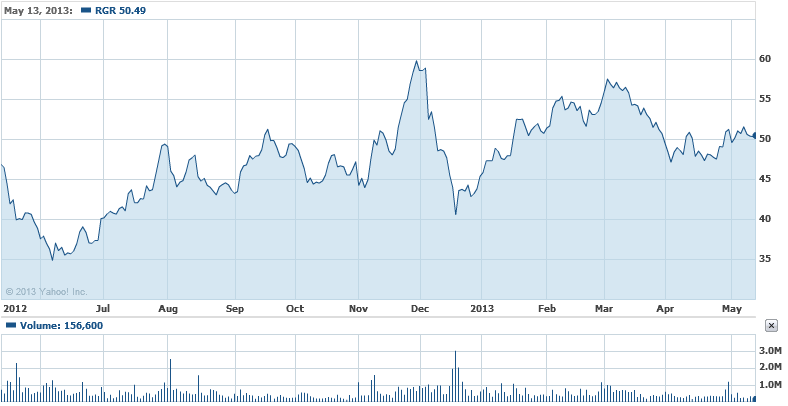
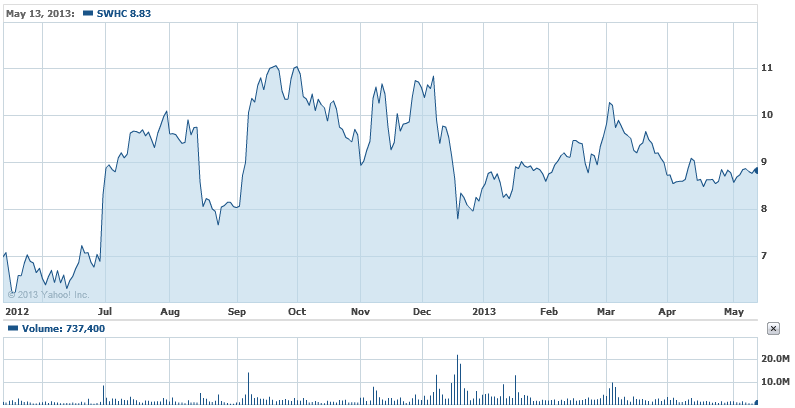
That means Sturm Ruger (RGR) and Smith & Wesson (SWHC) - as far as publicly traded companies go - are those facing more scrutiny and pressure. There are far more private gun manufacturers than these two - which is important from a competitive point of view - but as for media focus, they aren't as important in the public opinion wars at the national level, although locally they may get more heat.
As you can see in the two charts below, Sturm Ruger and Smith & Wesson - because of the exposure to news cycles - have been very volatile over the last year, although they have gradually moved up even after big spikes and declines on some trading days. That will be the way the share prices of the two companies perform going forward as well. Thus it's imperative to get in on the dips, as it could take some time to recover if you invest after big upward moves. You can see that with December sales for Sturm Ruger, and for seasonal sales from October through December with Smith & Wesson. Buying before people start thinking in terms of Christmas is important with these two stocks. Newtown of course was a part of the uptick in December sales.
Sturm Ruger
Smith & Wesson
(click to enlarge)
(click to enlarge)

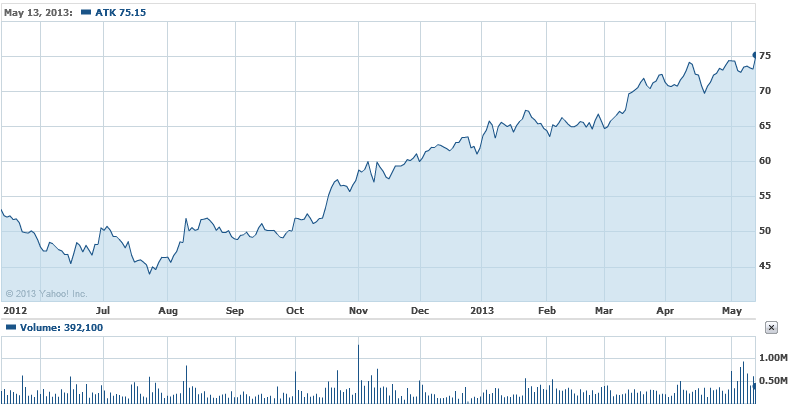
Alliant Techsystems (ATK) serves the aerospace/defense industry, which a significant part of that being the production of ammunition for the hunting and sports market. That includes ancillary goods such as gun care products, scopes, targets, and reloading equipment, among other related items.
ATK recently announced it is going to acquire Caliber Co., the parent company of Savage Sports. The price of $315 million represents a 5.5 multiple of its trailing-12-month EBITDA. Savage is one of the leading manufacturers of shotguns and hunting rifles, and fits in well with the overall product mix of Alliant. Adding a gun manufacturer to the ammunition line is a good move.
The company said it thinks Savage will be accretive to its current fiscal year earnings per share. Financing of the deal came from existing cash and its current credit facility. As you can see below, this should boost an already highly successful company.
Alliant Techsystems
(click to enlarge)
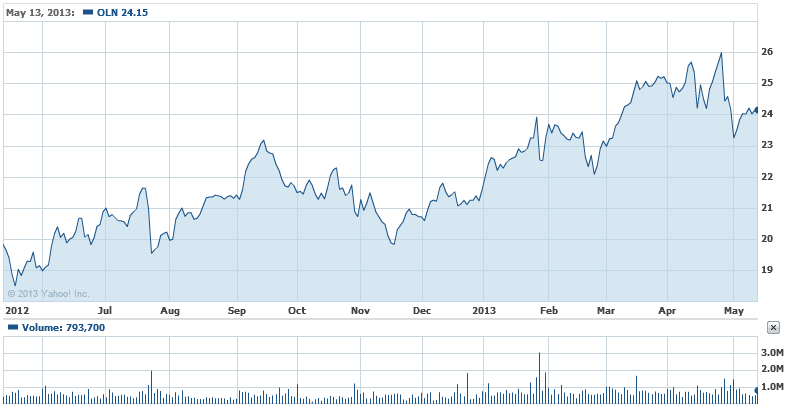
Another good option is Olin Corporation (OLN), which generates about 37 percent of its revenue from gun and ammunition sales. The other revenue comes from chlorine and alkaline products.
Another good option is Olin Corporation (OLN), which generates about 37 percent of its revenue from gun and ammunition sales. The other revenue comes from chlorine and alkaline products.
Over the last year, Olin has performed very well, with its Winchester unit helping boost the company.
Still, one has to view Olin differently than the rest of the players in this sector, as its totally different chemical units make it unique. Since 63 percent of revenue comes from chemicals, it must be primarily considered a investment in that sector rather than in firearms, although ongoing demand could easily boost revenue from the Winchester unit.
Consequently, this is a more predictable play than the pure gun and ammunition manufacturers over the last year.
Olin
(click to enlarge)
Another awesome stock to consider is Cabela's (CAB), which may be one of the best in this grouping here. The outdoors company has more than doubled its share price over the last year, and appears to have a lot of room to grow.
Gun and ammunition sales have helped them outperform, but what makes them even more compelling is when you strip out gun and ammunition sales, the company's same store sales still climbed by 9 percent, with 10 out of 13 merchandise subcategories increasing. This has partly to do with the perception the economy has been improving.
Along with impressive revenue growth is just as impressive earnings growth. Net income has also been solid. Cash flow from operations has also been up. One area of risk is its debt load, but the rest of the positives will overcome that if the solid performance of the company continues on.
The company said in its recent conference call that it's keeping exterior guidance in place, suggesting they may still have some significant upside potential, which will give the share price of the stock a big boost if it outperforms.
Cabela's
(click to enlarge)

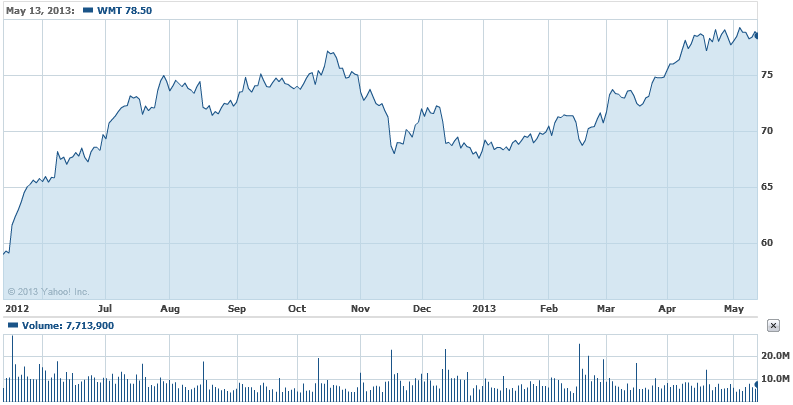
Finally, Wal-Mart (WMT), which is the biggest player in many sectors, is also one of the largest sellers of firearms and ammunition in the world. Obviously it'll be less affected by direct sales because of its enormous size, but the key factor there is the market it serves, which for the most part in America, is located in gun-supporting regions of the country.
That means potential for ancillary sales when people come in looking for ammunition and guns. The jump in sales and good will from its customer base is reflected in the nice move up in share price from a year ago.
Wal-Mart
(click to enlarge)
Risks
With such a positive environment for gun and ammunition sales, is there any risk in the near or medium term for companies selling guns and ammunition? The answer is yes, but not for the reasons I've been reading some writers assert.
According to them, it's the implementation of gun control measures which would snuff out the growth. Not only is that the furthest from the truth, it's the exact opposite.
What would stop this extraordinary growth? It would be to stop the aggressive attempt to restrict guns and gun ownership. As long as the public perceives an attack on the right to bear arms, they're going to continue to stock up on guns and ammo. If politicians would stop their attempts to regulate guns, most of the fears would subside and demand would be cut back.
The reason I say gun control laws wouldn't stop growth is people would continue to buy firearms and ammo whether laws are put in place or not. It would just be done from different outlets than they are buying from now. This could be a risk to gun retailers, but not to gun manufacturers.
In my view risk would be to lower the hype and rhetoric from some government mouthpieces and entities, which would cause gun owners to relax and ease up on buying guns and ammunition.
Since that's highly unlikely, as well as it being unlikely any significant legislation that would be a game changer being implemented, it looks like companies with strong exposure to guns and ammunition will continue to do well.
Higher prices aren't a risk, as they have continued to climb without making a dent in the rising demand. Other than food and water, gun enthusiasts consider firearms and ammunition as one of the most necessary items to own. That isn't going to change.
Competition
As mentioned earlier, a lot of the competition in the sector is from private companies, which are numerous around the country.
In the current atmosphere, that has had absolutely zero effect on demand and sales. Demand is so overwhelming that everyone, especially in the ammo field, have enormous supply challenges. This won't change any time soon.
There is no advantage here for the majority of companies, as whoever can provide the ammo and desired firearms will be the companies which get the sales. To a lesser extent this is true with some firearms, with brands playing a bigger role there.
Conclusion
While concerns over potential gun legislation has driven gun and ammunition demand, a secondary factor has been concerns over the economy and the resultant crime that always grows in response to economic weakness. That is going to remain the trend in the near future.
The main demand drive will remain gun control efforts though, and as long as the aggressive positioning and push continues on from politicians, and is reinforced by mainstream media outlets, there is no way the demand for guns and ammunitions is going to subside. After all, what would be the catalyst if things continue on as they now are?
Even after gun control efforts are swept aside by lawmakers, gun control advocates assert they'll never give up. While that may be true politically, it plays into the gun and ammunition demand scenario.
It's apparent there will be no disruptive gun control legislation in the near future, and those companies with exposure to guns and ammunition will continue to benefit from that reality.
Tuesday, May 7, 2013
Big Tech Starting To Bust A Move
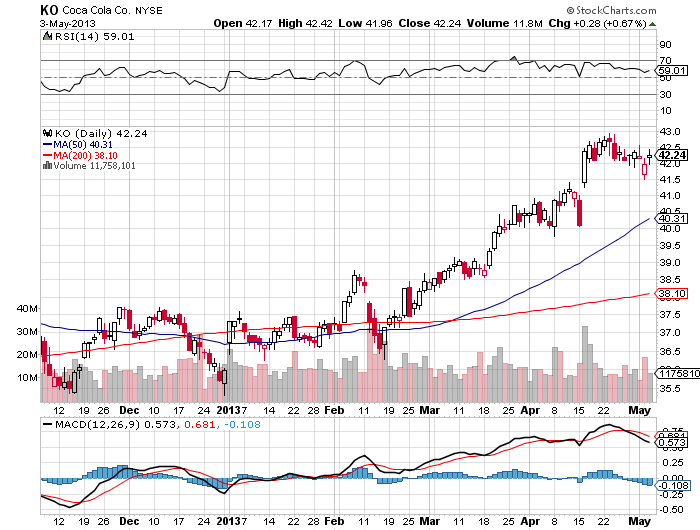
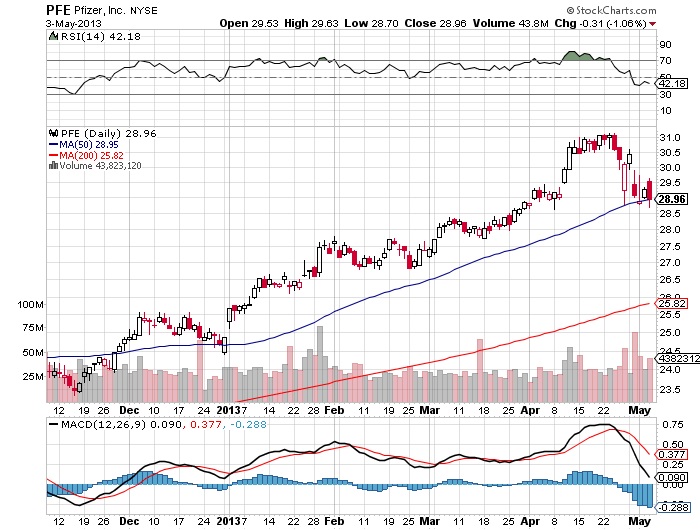
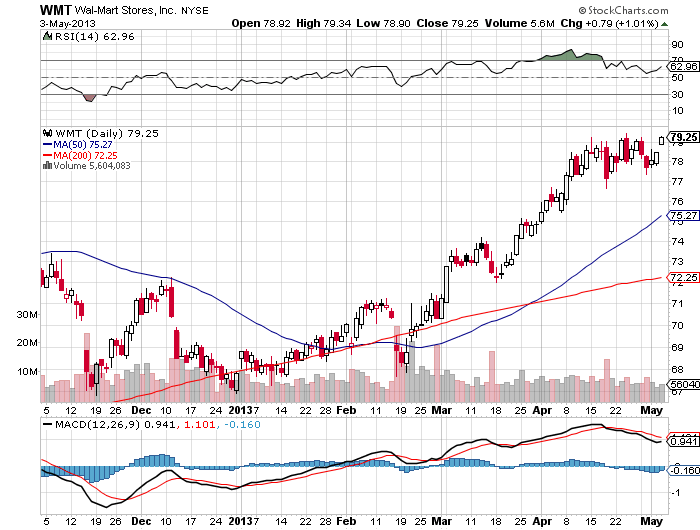
With the almost zero interest rates in place by the Federal Reserve, investors have been looking to blue chips and dividends as their main places to park their capital. This is why companies like Coca-Cola Company (KO), Wal-Mart (WMT), Pfizer (PFE) and Johnson & Johnson (JNJ) have been doing so well over the last six months to a year. This has happened because they're continually being forced out of bonds and cash into better-performing equities.
Here's how they've performed over the last year:
(click to enlarge)
(click to enlarge)
(click to enlarge)
(click to enlarge)
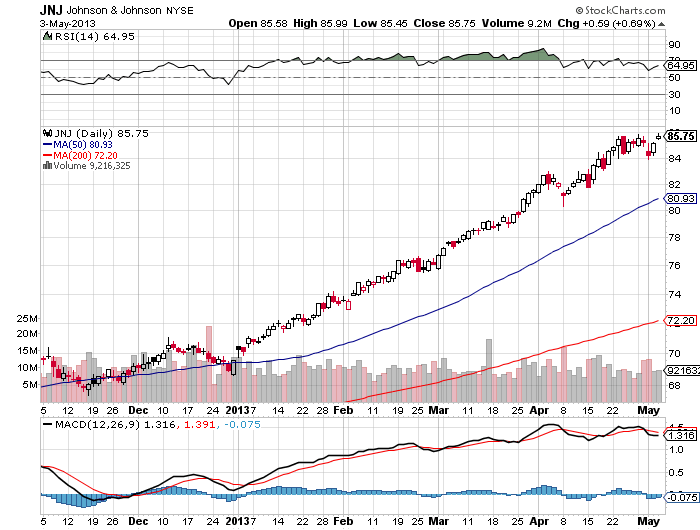
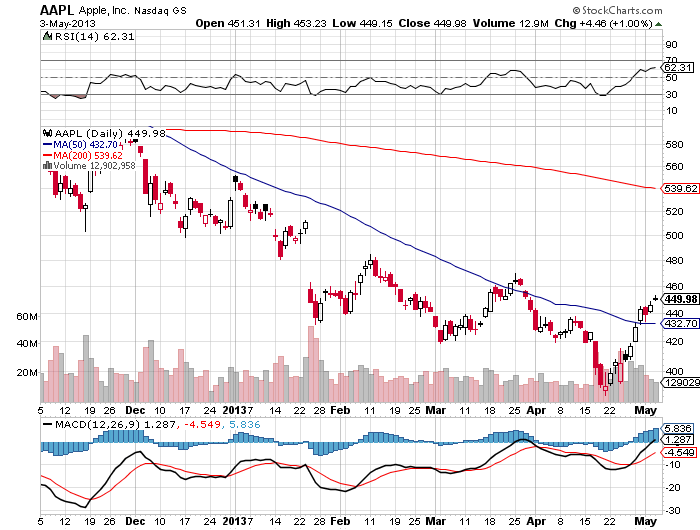
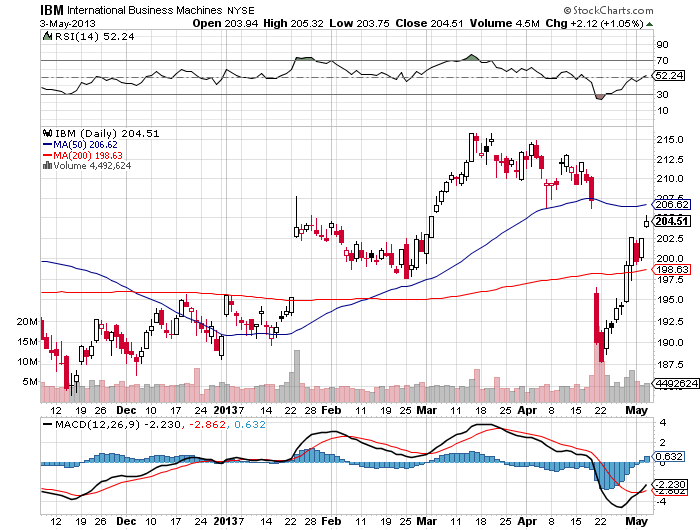
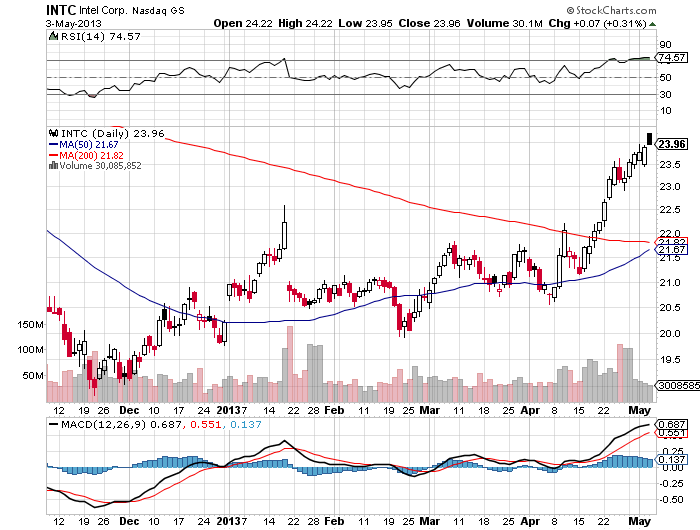
Recently the moved towards safer and better producing dividend companies has changed, as more and more capital is being allocated to the big tech sector, evidenced by upward moves in firms like Apple (AAPL), Microsoft (MSFT), Intel (INTC) and IBM (IBM). This began to happen from about April 15 to April 22.
Below are the charts of these four tech companies to confirm they have started to move up in a way that looks sustainable.
(click to enlarge)
(click to enlarge)
(click to enlarge)
(click to enlarge)

I know that IBM, after its recent earnings report took a big hit, and is still below its 50-day moving average, yet it began to move in unison with the other big tech stocks, confirming there is definitely a more positive outlook for tech, as well as a growing risk appetite by main street.
That tells me investors, because of move up in dividend-paying blue chips, are ready to take on a little more risk, and the upward move in big tech stocks implies that's where their money is now headed. It also tells you they may believe the blue chips have soared so high they may not have a lot more room to run. They may have peaked. Either way, money is starting to migrate to big tech, and it looks like they're ready for a nice run.
Over the last couple of weeks the big tech stocks have been outperforming the blue chips, lending credence to my supposition. The only question appears to be if they will pull back some in the short term, or we've entered fully into the trend already. Whichever it is, big tech companies are close to rockin'.
Apple
Apple, as with all these companies have unique circumstances, but I'm going to use the tech giant as a bellwether for the overall big tech industry to unveil why they're overall poised for an upward, bullish trend.
There are two important elements to consider with Apple and all the big tech companies, and that is the current price levels and the net cash positions of the companies (cash on hand minus debt).
The numbers used in this article will obviously change, but if you want to know the net cash position of any company you're interested in investing in, subtract debt from cash on hand and you'll know the strength or weakness in that regard.
Current Price Levels and Value
As you can see from the charts above, the current price levels of big tech companies are very attractive in light of the Federal Reserve policies and macro-economic conditions, as well as the net cash positions of the stronger companies.
The best way to see the value in a company is via its price-to-earnings (P/E) ratio.
Consider the amount of cash on hand with the large tech companies, as that alters the way we should look at the price-to-earnings ratio of each company.
With Apple, which is flush with cash, it dramatically changes the P/E equation. When I was checking out Apple's net cash position, the market value of the company was close to $415 billion. Cash on hand at that time was about $137 billion. You subtract
that from the $415 billion and the company is trading at only 6.7 times future earnings. That's an incredible bargain, to say the least.
So there is the combination of incredibly cheap stocks at the beginning of a significant uptrend. The sector has everything going for it at this time, and that should drive the share price of the companies up in a big way. It appears this ride has just begun.
Other Tech Companies
There are a number of tech companies that fit under this trend umbrella, including Google (GOOG), Microsoft and Cisco (CSCO).
Google is the most expensive of these, with a forward price-to-earnings ratio of 12.7. It has a market cap of $273.6 billion as of this writing, with cash on hand of $48.1 billion.
Microsoft is much cheaper, with a forward price-to-earnings ratio of 8.1. It's market cap is $276.4 billion, with cash on hand of $68.3 billion.
Cisco's forward price-to-earnings ratio is a paltry 5.8. It's market cap is $111.5 billion, with cash on hand of $46.4 billion.
There are other companies, but these are all set for a nice boost in share price, and that appears to be a trend that will go on over the next 6 to 12 months, possibly even longer. The blue chip trend lasted for about a year or so, and if that's an indicator that can be trusted, the big tech trend could experience the same time frame.
ProShares Ultra Technology (ROM)
One example of a technology ETF that will also do very well over the next year or so is ProShares Ultra Technology.
(click to enlarge)
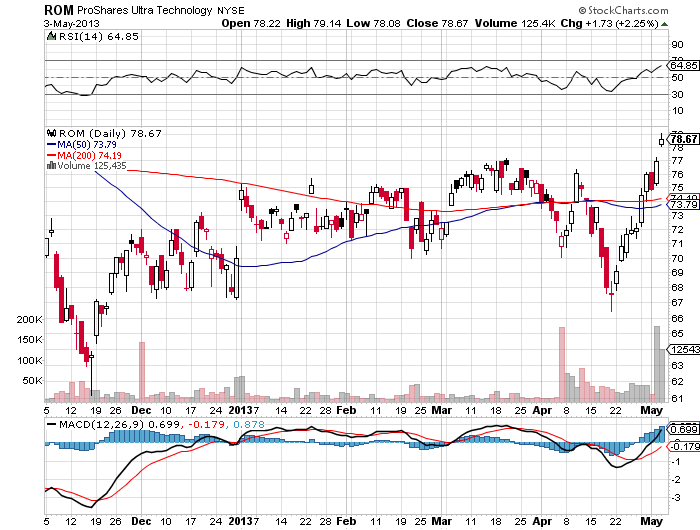
Calculating the forward price-to-earnings ratio in the larger holdings of the fund, the average stands at only 11. That's also an amazing ratio, which bodes well for those investing in this and similar big tech ETFs.
(click to enlarge)

Unsurprisingly, ProShares Ultra Technology has moved in unison with the big tech stocks.

Conclusion
To me trends are the most important element in the share price movement of companies, as they will overcome all sorts of data and opposition when the trend takes hold. Trends defy logic, and can pull up even less attractive companies on momentum and sector favor.
That's what's happening in the big tech sector at this time, and we're just at the beginning of a big move.
Other than end-of-the-world scenarios, I don't see anything will stop this from going forward.
About the only risk I see is in when it'll happen. Is it possible there could be a temporary pullback? Absolutely. In that case it's a matter of hanging on if you're already in and waiting for the rebound.
The other possible risk is if this is a misreading of investment sentiment towards big tech. It doesn't appear to be, as the overall movement of the sector over the last couple of weeks is unlikely to be a fluke or anomaly, and so should be something
that takes hold to the benefit of those willing to invest in the sector.
As for Apple itself, the company will definitely rebound on the trend, but the lack of any known pipeline will eventually weigh again on the stock. In the meantime, it may not become a skyscraper in light of the existing conditions, but it will definitely go higher because of the current price levels and the big tech trend.
We are at the crux of this new trend, and while it may be a little early (maybe), it's very close to being time to get into the sector before it begins to soar.
Remember this is happening because of an increased risk appetite, attractive entry points, and low forward price-to-earnings ratios.
Subscribe to:
Posts (Atom)